Cloud computing is when companies rent and share computers owned by a tech provider, accessing them over the internet. They do this instead of buying them and installing them in their own data center, which is the old way of doing things.










Cloud computing is when companies rent and share computers owned by a tech provider, accessing them over the internet. They do this instead of buying them and installing them in their own data center, which is the old way of doing things.
Cloud computing is one of the most popular subjects discussed in the mobile industry today. As we enter more deeply into 2015, we should look more closely at the compelling argument for extending applications into the cloud/hybrid cloud to address the need for fast, flexible capacity.
Most enterprise IT departments now manage applications across multiple environments in a dizzyingly complex overall IT architecture. They also must constantly reevaluate their unique mix of on-premises, private cloud and public cloud infrastructure to meet new business goals and determine how applications can be migrated to the public cloud in a cost-effective way.
Recent research reveals that while women account for about one-half of the labor force, their numbers for employment in science, technology, engineering, and math (STEM) fields continues to lag behind men.

Hybrid cloud architecture is quickly becoming the preferred way of conducting business among cloud providers.
The rate that our technological advances are achieved, is increasing. Many studies have tracked the advances of many different measures of information technology, and have identified that performance (in relation to price) doubles on average every 18 months. As the rate of our advances continues to accelerate, the future continues to come faster than we traditionally expect.
We need to store all that data somewhere. Hard drives were our only resort a few decades ago. Today, cloud is the new frontier on the data storage land, brimming with features.

Enterprise mobility is a term that describes a shift in work habits, with more employees working out of the office and using mobile devices and cloud services to perform business tasks.
For the past several years, companies have been moving their operations to the cloud in increasing numbers. Economics are one driver.
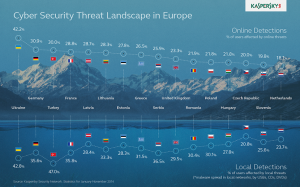
The Kaspersky Lap held a Cyber Security Weekend conference in Warsaw, where they explored the latest cybercrime trend and discussed how European businesses can survive in a world of cyber security threats.



Follow me on Social Media